Millennials Didn't Break the Housing Market — The Numbers Were Already Broken Before They Got There

Photo by Vitaly Gariev on Unsplash
Millennials Didn't Break the Housing Market — The Numbers Were Already Broken Before They Got There
Somewhere around 2016, a particular genre of financial commentary reached peak saturation. The argument went like this: millennials weren't buying homes because they were spending irresponsibly. Too many lattes. Too many streaming subscriptions. Too much avocado toast — a phrase that became so culturally loaded it ended up in congressional testimony.
The implication was clear: if younger Americans would just make smarter choices, the path to homeownership would open right up.
Economists who study housing markets found this framing somewhere between frustrating and baffling. Because the data, when you actually look at it, tells a story that has almost nothing to do with brunch habits.
What the Blame Narrative Got Wrong
The 'millennials aren't buying homes because of their spending' argument has one significant flaw: it treats homeownership as primarily a willingness problem rather than a math problem.
But housing affordability is, at its core, a math problem. And the math stopped working long before millennials were old enough to apply for a mortgage.
Here's the core issue. For most of the 20th century, the ratio of median home prices to median household income stayed relatively stable — generally somewhere between two and four times annual income. That ratio started climbing in the 1970s and 1980s, accelerated through the 1990s, and by the time millennials entered the workforce, had reached levels that made the traditional 20% down payment genuinely difficult to accumulate even for people with professional salaries and disciplined spending.
In many major American metros — the places where jobs actually exist — median home prices have reached eight, ten, or even fifteen times median household income. No amount of cutting back on subscription services closes that gap.
The Structural Forces That Actually Shaped the Market
Three factors show up consistently in housing economics research, and none of them are related to generational spending habits.
Wage stagnation. Real wages for American workers in the bottom and middle of the income distribution have grown slowly since the 1970s. Housing prices, meanwhile, have not been similarly restrained. The gap between what homes cost and what most workers actually earn has widened steadily over decades. That's not a millennial problem — it's a structural labor market problem that was accumulating long before the oldest millennials graduated high school.
Zoning and land use restrictions. This one rarely makes headlines but housing economists consider it one of the most significant drivers of unaffordability. Local zoning laws in most American cities heavily restrict the construction of multi-family housing, limit density, and make it expensive and slow to build new units. When housing supply can't keep up with demand — and in most major metros, it hasn't for decades — prices rise. Again, this is a policy problem with roots stretching back to the mid-20th century.
Investor activity and institutional buying. The post-2008 housing recovery saw significant institutional investment in single-family homes, particularly in Sun Belt markets. Large investment firms purchased tens of thousands of homes to convert to rentals, removing inventory from the for-sale market at exactly the moment first-time buyers were trying to re-enter it. Individual investors and short-term rental platforms added additional pressure in desirable markets.
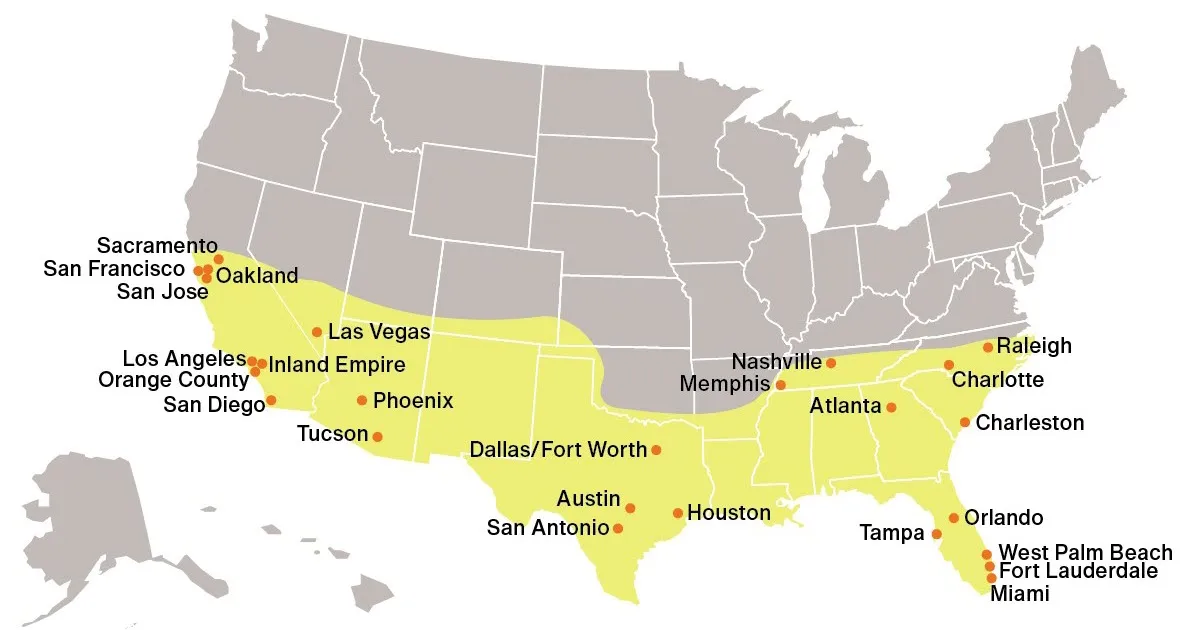 Photo: Sun Belt, via www.clarionpartners.com
None of these forces are things a 29-year-old with a moderate income could have prevented by ordering fewer delivery meals.
The Student Loan Factor Nobody Wants to Discuss
There's one more piece of the puzzle that the 'irresponsible millennials' narrative consistently sidesteps: student debt.
Americans collectively hold over $1.7 trillion in student loan debt, and millennials hold a disproportionate share of it. This matters for homeownership in a very direct way. Mortgage lenders look at debt-to-income ratios. A borrower carrying $500 a month in student loan payments qualifies for a meaningfully smaller mortgage than an otherwise identical borrower without that obligation.
Millennials were also the first generation to graduate into the aftermath of the 2008 financial crisis — a period of high unemployment and suppressed wages during the exact years when previous generations were building early career savings and accumulating down payment funds. That timing wasn't a choice. It was circumstance.
Why the Blame Story Was So Easy to Tell
The generational blame narrative was appealing for a few reasons. It was simple. It placed responsibility on individuals rather than systems. And it neatly fit a longer cultural tradition of older generations viewing younger ones as less disciplined and more indulgent.
It also made good media content. 'Zoning reform and wage stagnation are suppressing first-time homebuyer rates' is accurate but not particularly clickable. 'Are millennials too obsessed with experiences to buy homes?' writes itself.
The problem is that framing the issue as a personal finance failure obscures the policy conversations that might actually help — conversations about housing supply, zoning reform, wage growth, and the role of investor activity in residential markets.
The Actual Picture
Millennial homeownership rates are lower than previous generations at the same age. That part is true. But the explanation isn't lattes — it's a housing market that became structurally harder to enter over several decades, a student debt burden without historical precedent, and a labor market that didn't fully recover from the 2008 crash until well into the 2010s.
The math was already broken. Millennials just happened to show up when the bill came due.