Lightning Absolutely Strikes the Same Place Twice — and Meteorologists Are Exhausted Explaining This
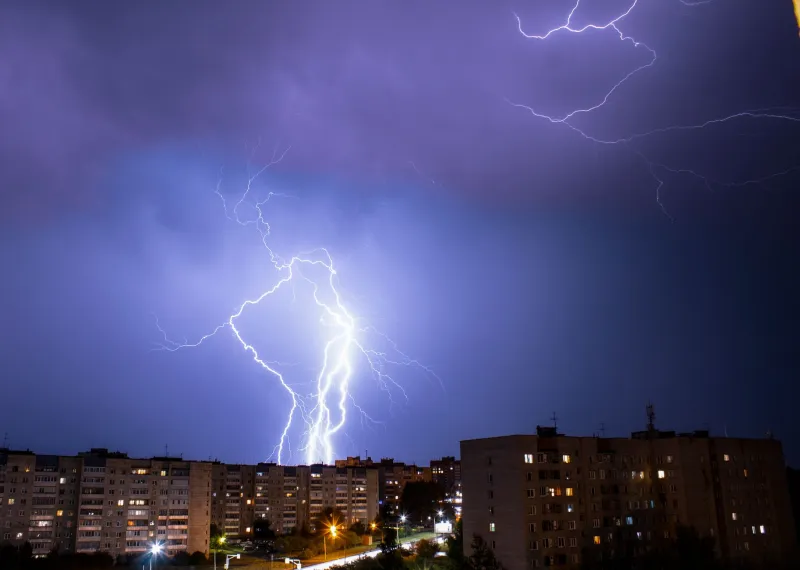
There are phrases so deeply embedded in everyday speech that nobody stops to question whether they're actually true. "Lightning never strikes the same place twice" is one of those phrases. You've heard it at family barbecues, used it yourself as a metaphor for bad luck, maybe even taken a small amount of comfort in it during a thunderstorm.
The problem is that it's wrong. Not slightly off. Not a simplification. Completely, demonstrably, and sometimes dangerously wrong.
What Lightning Is Actually Looking For
Lightning doesn't wander randomly through the sky looking for fresh targets. It follows the path of least electrical resistance from storm clouds to the ground — and certain features of the landscape make some spots far more attractive than others. Height matters. Conductivity matters. Isolation matters.
This is why tall trees, metal structures, hilltops, and open fields get hit over and over again. The Empire State Building in New York City, for example, is struck by lightning roughly 20 to 25 times every year. The same building. The same spot. Year after year. That's not a fluke — that's physics doing exactly what physics does.
 Photo: Empire State Building, via www.travelguide.net
The entire concept behind a lightning rod, which Benjamin Franklin invented in the 18th century, is built on the premise that lightning will return to the same location. You put a conductive rod at the highest point of a structure, and the rod draws repeated strikes safely into the ground. If lightning never returned to familiar targets, lightning rods would be pointless.
 Photo: Benjamin Franklin, via templeofzeus.org
So the technology that has protected buildings for over 250 years directly contradicts the saying most Americans grew up repeating. That's a pretty significant gap between folk wisdom and engineering reality.
Where the Saying Actually Came From
The phrase has been traced back to at least the mid-1800s, appearing in print as both a literal weather observation and a metaphorical comfort about misfortune. In an era before meteorology was a serious scientific discipline and before most people had any framework for understanding electrical storms, it made a kind of intuitive sense. Lightning felt random. Random things, the thinking went, don't repeat themselves in the same place.
The metaphorical version — meaning that bad luck doesn't usually hit the same person twice — is where the phrase really took hold. It migrated from weather observation into everyday encouragement, the kind of thing you say to someone going through a rough patch. That emotional utility kept it alive long after the underlying science was understood well enough to disprove it.
Once a phrase becomes metaphorically useful, it tends to stick around regardless of whether it's literally accurate. Nobody questions "the sun rises in the east" for astronomical precision. And nobody questioned the lightning saying because it felt reassuring, and reassuring things rarely get fact-checked.
Why This Myth Is More Than Just Harmless
For most misconceptions, the stakes are low. Believing that goldfish have bad memories or that Napoleon was short doesn't put anyone in danger. The lightning myth is different.
Safety researchers and meteorologists have documented cases where people made genuinely risky decisions based on this belief — sheltering under a tree that had already been struck, assuming a recently hit area was somehow "used up" and therefore safe, or dismissing the need to move after a nearby strike on the grounds that lightning wouldn't return. The National Weather Service lists lightning as one of the leading causes of weather-related deaths in the United States, killing an average of around 20 people per year and injuring hundreds more.
 Photo: National Weather Service, via ewscripps.brightspotcdn.com
Those numbers could be lower if people followed actual safety guidance instead of folk sayings. The real rules are less poetic but considerably more useful: get indoors or into a hard-topped vehicle when a storm approaches, stay away from tall isolated objects, avoid open water and open fields, and don't assume any outdoor location is safe just because it looks like it hasn't been hit recently.
Meteorology experts have been trying to correct this one for decades. It keeps coming back.
The Comfortable Fiction Problem
Part of what makes this myth so persistent is that it offers something people genuinely want during a thunderstorm: a reason not to worry. Anxiety is uncomfortable. A saying that suggests lightning is done with a particular spot is emotionally convenient, even if it has no basis in atmospheric science.
This is a pattern that shows up across a lot of popular misconceptions. The myths that survive longest tend to be the ones that make people feel better in the moment — about their health, their safety, their choices. The truth, which is that lightning can and does return to the same spot repeatedly and that your best option is to take shelter immediately regardless of what happened a moment ago, is less comforting. But it's the version that actually keeps you safe.
What to Actually Do in a Storm
The National Weather Service recommends the 30-30 rule as a starting point: if you see lightning and hear thunder within 30 seconds, get to safety immediately, and wait at least 30 minutes after the last clap of thunder before going back outside. No exceptions for spots that "already got hit." No comfort in the idea that lightning has moved on.
When you're caught outside, avoid tall isolated trees, hilltops, open water, open fields, and metal structures. A hard-topped car with the windows up is a reasonable option if a building isn't available — the metal frame routes electricity around the occupants rather than through them.
The phrase "lightning never strikes the same place twice" can stay in the language as a metaphor for bad luck. Just don't use it as a weather safety strategy. The Empire State Building would like a word.
The takeaway: Lightning actively favors the same locations repeatedly because it follows electrical resistance, not random chance. The saying is a metaphor that got mistaken for science, and in the context of actual storms, it's one worth forgetting entirely.