Scientists Spent Decades Calling 98% of Your DNA 'Junk' — They're Still Walking That Back
Scientists Spent Decades Calling 98% of Your DNA 'Junk' — They're Still Walking That Back
If you took a biology class anytime between the 1970s and the early 2000s, you probably picked up a striking fact: only about 2% of your DNA actually does anything. The rest, the story went, was evolutionary debris — broken genes, ancient viral remnants, and random sequences that accumulated over millions of years without ever serving a purpose. Scientists had a name for it: junk DNA.
It was a clean, memorable idea. And like a lot of clean, memorable ideas in science, it turned out to be significantly wrong.
Where the 'Junk' Label Actually Came From
The term was coined in 1972 by geneticist Susumu Ohno, who used it to describe the large portions of the genome that didn't appear to code for proteins. At the time, that framing made reasonable sense. Early molecular biology had established that genes work by encoding instructions for building proteins, and the sequences that did that job accounted for only a small fraction of the total genome. Everything else looked, to the tools available at the time, like noise.
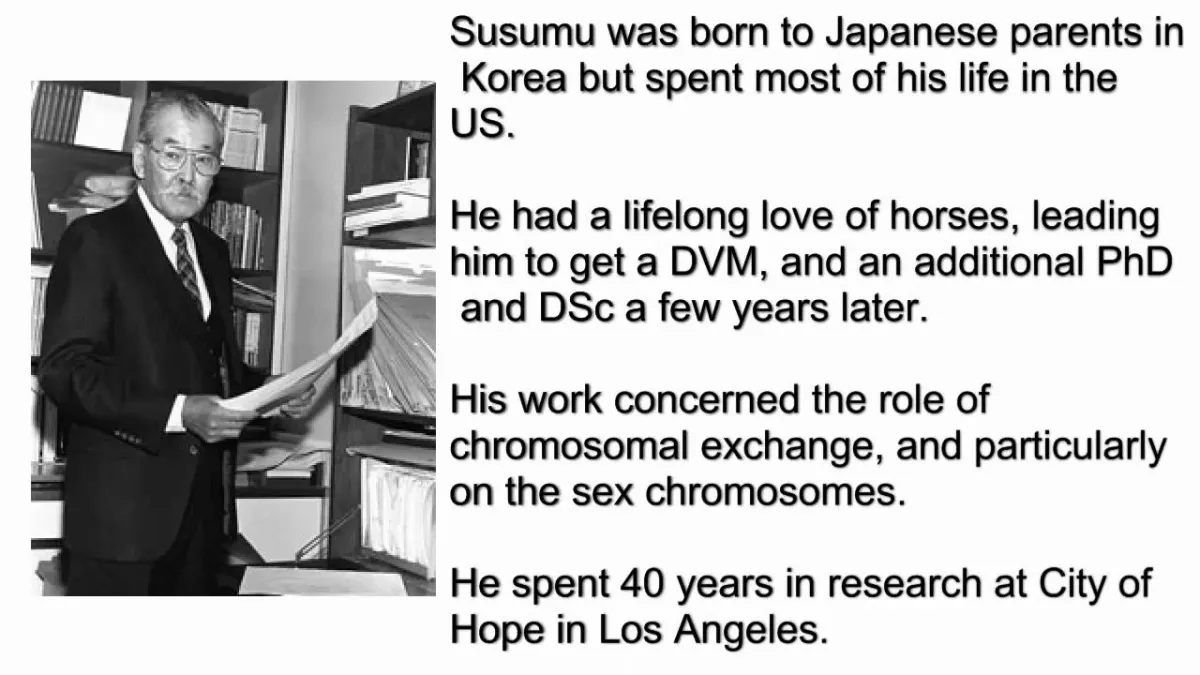 Photo: Susumu Ohno, via i.ytimg.com
The label stuck partly because it was useful shorthand and partly because it fit a broader narrative about evolution — the idea that natural selection doesn't clean up after itself, and that genomes accumulate all kinds of historical baggage over time. By the 1990s, 'junk DNA' had migrated from scientific papers into textbooks, magazine articles, and popular science books, where it hardened into received wisdom.
The problem is that absence of evidence isn't evidence of absence. Early researchers couldn't find a function for most of the genome largely because they weren't yet equipped to look for one.
What Researchers Actually Found When They Looked Closer
The real turning point came in 2012, when a massive international research effort called ENCODE — the Encyclopedia of DNA Elements — published a landmark set of findings. The project involved hundreds of scientists analyzing the human genome in unprecedented detail, and what they found complicated the junk narrative considerably.
ENCODE researchers determined that roughly 80% of the genome showed signs of biochemical activity. That didn't mean every stretch of DNA was performing some critical function, and the findings sparked genuine debate among geneticists about how to define 'functional.' But it made clear that the old picture — coding genes doing real work, everything else sitting idle — was far too simple.
A significant portion of what had been labeled junk turned out to include regulatory elements: sequences that don't build proteins themselves but instead act like switches, dials, and timers that control when and how protein-coding genes get turned on or off. Others are involved in producing different types of RNA that play roles in gene expression, chromosome structure, and cellular development. Some sequences that look like broken remnants of ancient viruses appear to have been repurposed by the genome for entirely new jobs.
None of this means every base pair is doing something vital. But 'mostly useless' and 'we hadn't figured out the use yet' are very different statements.
Why the Myth Became So Sticky
The 'junk DNA' story persisted for so long partly because it got locked into educational materials before the science moved forward, and partly because it had a satisfying quality to it. It suggested that even something as fundamental as the human genome was inefficient and messy — which felt honest and counterintuitive in a way people found compelling.
There's also a parallel with the '10% of your brain' myth, which traveled a similar path from scientific oversimplification to cultural fixture. Both ideas took a legitimate early observation — that much of the genome didn't code for proteins, that much of the brain wasn't firing at any given moment — and turned it into a sweeping claim about uselessness. Both claims spread because they were easy to explain in a sentence. And both turned out to be far more misleading than informative.
Media coverage didn't help. When ENCODE released its findings, some outlets reported that scientists had 'debunked junk DNA entirely,' which overcorrected in the other direction. The reality — that the genome is more functional than previously understood, but that the full picture is still being worked out — is harder to fit into a headline.
What This Actually Means for You
In a practical sense, this isn't about second-guessing your high school biology teacher. But it matters in a few real ways.
Understanding that non-coding DNA plays regulatory roles has changed how researchers think about genetic disease. Many conditions that couldn't be explained by mutations in protein-coding genes are now being traced to changes in regulatory regions — areas that would have been dismissed as junk a generation ago. That shift has opened up new directions in medicine, including research into conditions like cancer, heart disease, and autoimmune disorders.
It also offers a broader lesson about how scientific communication works. A simplified explanation, repeated often enough, becomes a fact in the public mind even as the underlying science keeps moving. The genome didn't change. The tools and methods used to study it did.
The Takeaway
The 'junk DNA' label made sense given what researchers knew in 1972. What it didn't do was leave room for what they hadn't found yet. Science rarely produces final answers on the first pass, but the way those early answers get communicated to the public often suggests otherwise. Most of your DNA isn't useless. It's just that figuring out what it's doing has taken longer than anyone expected — and that work is still very much ongoing.